


The Merchant of Venice (1936)

Updated: Mar 3, 2023
Maccabi GB’s Stand Up! project is about to embark on a brand-new educational initiative in partnership with the Watford Palace Theatre and its new production ‘The Merchant of Venice (1936)’ starring the brilliant Tracy-Ann Oberman in the role of Shylock.

The widely advertised play, is a matriarchal twist on Shakespeare’s Merchant of Venice, aiming to reclaim a character – shylock - used for 427 years to perpetuate antisemitic stereotypes, creating an opportunity to learn about Jewish resistance, and the common struggles of minority, marginalised communities as seen during the Battle of Cable Street in 1936.
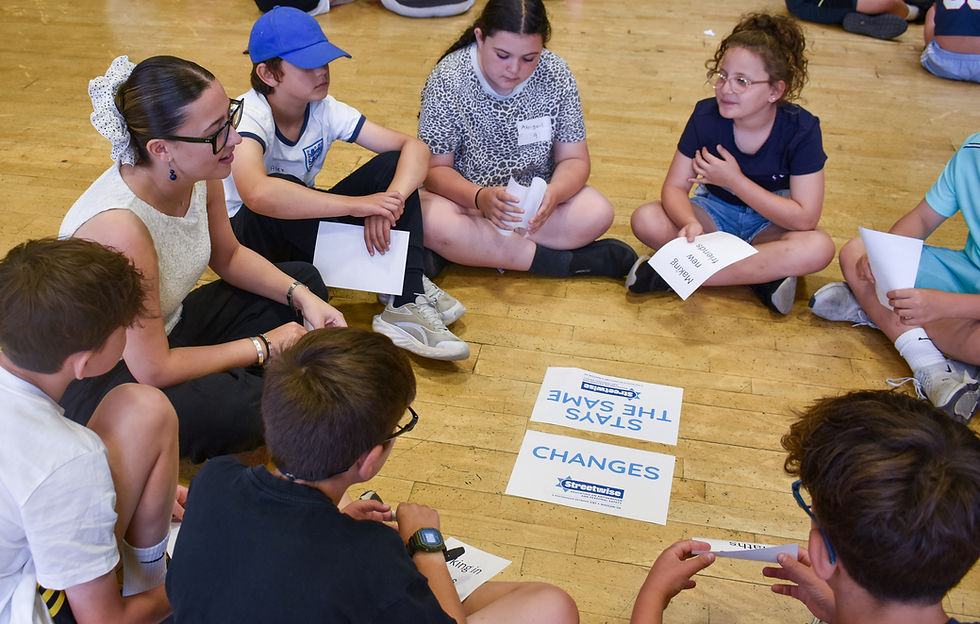
Stand Up! Education Against Discrimination is an interfaith, anti-discrimination project, led by Maccabi GB and in partnership with CST. The project brings Jewish and Muslim facilitators into secondary schools, delivering workshops that empower students to learn about and act against racism, discrimination, antisemitism and anti-Muslim hate. Launched in 2017, Stand Up! has engaged with 70,000 secondary school students nationwide, and has a proven track-record of effective impact on young people’s attitudes and behaviours around discrimination.
In 2022, the Watford Palace Theatre, together with Watford FC, chose Stand Up! to become the educational partner for the production; with over 600 young people invited to see the show from local Hertfordshire schools, the play presented a unique opportunity to further educate on antisemitic tropes and stereotypes in three different historical periods.
Whilst the play correlates Shakespeare’s themes with those of the 1930s’ rise of fascism in Britain, the bespoke Stand Up! workshops will take a further step, discussing similar themes in the present day, with the aim to provide students with tools to identify scapegoating and othering language. A newly developed digital platform designed by Watford Palace Theatre, will further guide the students in their learning, providing a truly multifaceted approach to the educational process.
The timing of the show is particularly important; CST’s latest ‘Antisemitic Incidents Report’ highlights the high number of incidents taking place in educational settings, targeting Jewish teachers and students, as well as many occurring within all levels of football. The partnership with Watford FC, who will host the educational workshops, is a wonderful example of communal collaboration and anti-discrimination social action.
About the collaboration, Tracy-Ann Oberman said: “The Merchant of Venice 1936 is the project of my life. Merging my desire to make important political exciting theatre with the ability to challenge, educate and motivate audiences. So to work with Stand Up! on this and partner to make a real difference with this reimagining of a notoriously difficult play, is a real privilege”.
The play’s Director, Brigid Larmour of Watford Palace Theatre said: “We're proud to be collaborating with the brilliant experts at Stand Up! on this important educational work, conceived as part of our Merchant of Venice 1936 project”.


Wall repairs help maintain the appearance and condition of interior spaces. Everyday activities can cause scratches, dents, nail holes, and small cracks in painted surfaces. Minor damage can often be repaired using suitable filler, sanding materials, and matching paint. Larger cracks or recurring damage may indicate structural movement or moisture https://handymanhub.com/ problems. Preparing the surface properly before applying paint helps create a smoother finish and improves the durability of the repair.
I loved how you highlighted the 1936 adaptation's unique take on Shylock. It reminded me of Slope 2 dynamic interpretations in modern media. What do you think makes this version distinct from others?
For people learning about Wi-Fi administration, 10.0.0.1 piso wifi can be an interesting search topic. A useful explanation should describe the general purpose of the settings and make it clear that the available controls depend on the specific router or Wi-Fi system being used.
I found my way to this post from nopeatnetticasinot.net, and I’m really glad I did — the idea of reclaiming Shylock through a 1936 lens is powerful. The workshops for students, especially with the digital platform and Watford FC partnership, sound like a meaningful way to turn theatre into real anti-discrimination action. Thanks for highlighting such an important collaboration.
I found the 1936 adaptation’s attempt at visual authenticity quite intriguing, especially the detail about its costume design. Overall, while I appreciate the historical effort, the film does seem to flatten Shylock’s character, losing some nuance. In the middle of researching this I ran into https://de.trustpilot.com/review/casinoohnelizenz.org, it made basically the same point.